|
Unfortunately for
Chelley, getting to New York leaves her spent. While all around
her are hustling editors and making deals for their latest
books, Chelley has nothing to sell. In the meantime, her husband
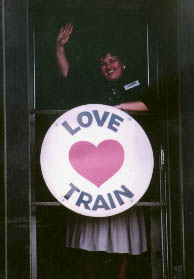 Ted, who at first opposed the Love Train, has a sudden change of
heart. After seeing Chelley's picture in Newsweek Ted realizes
that "my wife has done something that the average person walking
down the street, or the average person in Hollywood, couldn't
do." As Chelley prepares to return home from New York she vows
never to attend another romance conference without a completed
manuscript "under my belt." The vow is soon broken; Chelley's
passion for romance novels getting the better of her. A few
months later we see her at a romance conference in Anaheim as
she stands in line with other dedicated fans, waiting to have
copies of Janet Dailey's latest novel autographed by the author.
Chelley concedes that she was never really after the money, and
that she did everything, including the Love Train, "all for the
love of it." The Love Train has taught her that "I can do
anything if I put my mind to it." Ted, who at first opposed the Love Train, has a sudden change of
heart. After seeing Chelley's picture in Newsweek Ted realizes
that "my wife has done something that the average person walking
down the street, or the average person in Hollywood, couldn't
do." As Chelley prepares to return home from New York she vows
never to attend another romance conference without a completed
manuscript "under my belt." The vow is soon broken; Chelley's
passion for romance novels getting the better of her. A few
months later we see her at a romance conference in Anaheim as
she stands in line with other dedicated fans, waiting to have
copies of Janet Dailey's latest novel autographed by the author.
Chelley concedes that she was never really after the money, and
that she did everything, including the Love Train, "all for the
love of it." The Love Train has taught her that "I can do
anything if I put my mind to it."
The Love Train and Chelley's story are the threads for this
documentary probe into the world of romance novels, where
romance is not just a bed of roses, but a hotbed of social and
ideological discord. Authors and editors debate how much sex
there should be in books, what type of hero and heroine is
acceptable, and how to write about kissing. There are wild
success stories, a cynical journalist looking for a man, a mock
wedding, and a trainload of aspiring writers hoping that romance
will be the ticket to fame and fortune.
Where the Heart Roams was produced, directed and edited by
George Csicsery, who began to research the subject for two
magazine articles he published in 1982. The film was shot by
noted San Francisco Bay Area filmmaker and cinematographer John
Knoop. Original music for Where the Heart Roams was composed by
Mark Adler, one of the most talented young score composers
(then) in the San Francisco Bay Area, and a film director in his
own right. Mark Adler also conducted the Love Train Symphonette
in his own arrangement of music to accompany Barbara Cartland's
performance of the songs "A Nightingale Sang in Berkeley Square"
and "Love is My Reason."
|