Julia Robinson's 1939 transfer from San Diego State College to the University of California at Berkeley was the key to the direction of her future work. At age 22 she married one of her teachers, the mathematician Raphael Robinson. When she went into a deep depression upon learning that having children was too risky, due to lingering damage to her heart from the rheumatic fever she had suffered from as a child, Raphael reminded Julia that she need not despair, saying, "there is still mathematics."
Julia had the good fortune to study and work among some remarkable refugees from Nazi-occupied Eastern Europe, including Alfred Tarski, a towering figure in mathematics and logic. In 1948 she earned her Ph.D. under Tarski. It was Tarski who first drew her attention to H10. As Robinson wrote, "the problem has occupied the largest portion of my professional career. It was Tarski, talking to Raphael, who started me off. Tarski wondered whether one could prove that the powers of two cannot be put in the form of a solution of a Diophantine equation. Raphael mentioned the problem to me when he came home. And I began to work on it without saying anything to Tarski."
Hilbert's belief that there was a unified theory of mathematics, and that it would be discovered piece by piece, is addressed by mathematicians who will explain why the tenth problem commanded such compelling interest to Julia Robinson and the others who worked on it.
Hilbert's tenth problem (H10), stated in a more accessible way, asks the following: Given a Diophantine equation with any number of unknown quantities, devise a process according to which it can be determined whether the equation is solvable in whole numbers.
 Discussing H10 requires both verbal and graphic explanations of key mathematical ideas, such as Diophantine equations. The explanations were filmed in interview and classroom presentation style with mathematician Steven Givant, Bjorn Poonen, and Kirsten Eisenträger. An animated sequence of a Turing machine was designed by Andrea Hale. Discussing H10 requires both verbal and graphic explanations of key mathematical ideas, such as Diophantine equations. The explanations were filmed in interview and classroom presentation style with mathematician Steven Givant, Bjorn Poonen, and Kirsten Eisenträger. An animated sequence of a Turing machine was designed by Andrea Hale.
Why H10 was an important problem is discussed in relation to the development of computability, and requires explanations of the concepts of solvability and unsolvability. If a problem is unsolvable and a computer is set to try and solve it, the computer will work into eternity without finding a solution.
Nearly 50 years after Hilbert had asked whether a problem had a solution or not, the question began to consume Julia Robinson. On the east coast, Martin Davis and Hilary Putnam also became obsessed with H10 about the same time as Julia Robinson. Martin Davis describes his early interest in the problem and his exciting collaboration with Hilary Putnam.
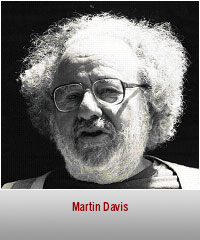 "For me the best part of the summer of 1954, which I spent at the Moore School, was getting to know Hilary Putnam, who was living in the same prefab housing complex for graduate student and junior faculty families," wrote Davis. "To my surprise, he was interested in Hilbert's tenth problem and proposed that we collaborate." Putnam and Davis began working together in earnest in 1957. Hilary Putnam recalls the collaboration this way: "What I remember from that summer is not so much the mathematical details as the sheer intensity with which we worked. I have never in my life been so absorbed in a mathematical problem, and I'm sure the same was true of Martin." "For me the best part of the summer of 1954, which I spent at the Moore School, was getting to know Hilary Putnam, who was living in the same prefab housing complex for graduate student and junior faculty families," wrote Davis. "To my surprise, he was interested in Hilbert's tenth problem and proposed that we collaborate." Putnam and Davis began working together in earnest in 1957. Hilary Putnam recalls the collaboration this way: "What I remember from that summer is not so much the mathematical details as the sheer intensity with which we worked. I have never in my life been so absorbed in a mathematical problem, and I'm sure the same was true of Martin."
Davis and Julia Robinson first met at the International Congress of Mathematics in 1950. It was a meeting at which no representatives from Iron Curtain countries were present. As Martin Davis and Constance Reid explain in the film, the political wall between East and West during the cold war began to take a toll on the exchange of scientific information. As the story of the solution to H10 unfolds, the audience will see how the passionate pursuit of knowledge by several mathematicians on both sides of that wall succeeded in bridging political barriers. "We mathematicians are all from one country," wrote Robinson.
|